Electrical helpers from abroad: when projects depend on installation capacity
Cable pulling, cable trays, pre-assembly: what electrical helpers from Eastern Europe take on, what stays with the qualified electrician and how to plan.
Many electrical projects today do not stall at the planning stage but at installation. Grid connections, building services and industrial installation often run at the same time, and your own crew is no longer enough for the cable pulling. If you plan electrical helpers from abroad, you gain capacity for exactly the work that takes a lot of time but does not need to tie up a qualified electrician. This article shows which tasks helpers and skilled helpers can take on and where the line to the responsibility of the qualified electrician runs. It also covers how staff leasing from Eastern Europe works in practice and what lead time to expect. The figures given are guide values, not wishful numbers. How much reinforcement a project can absorb is ultimately decided by you and your technically responsible staff.
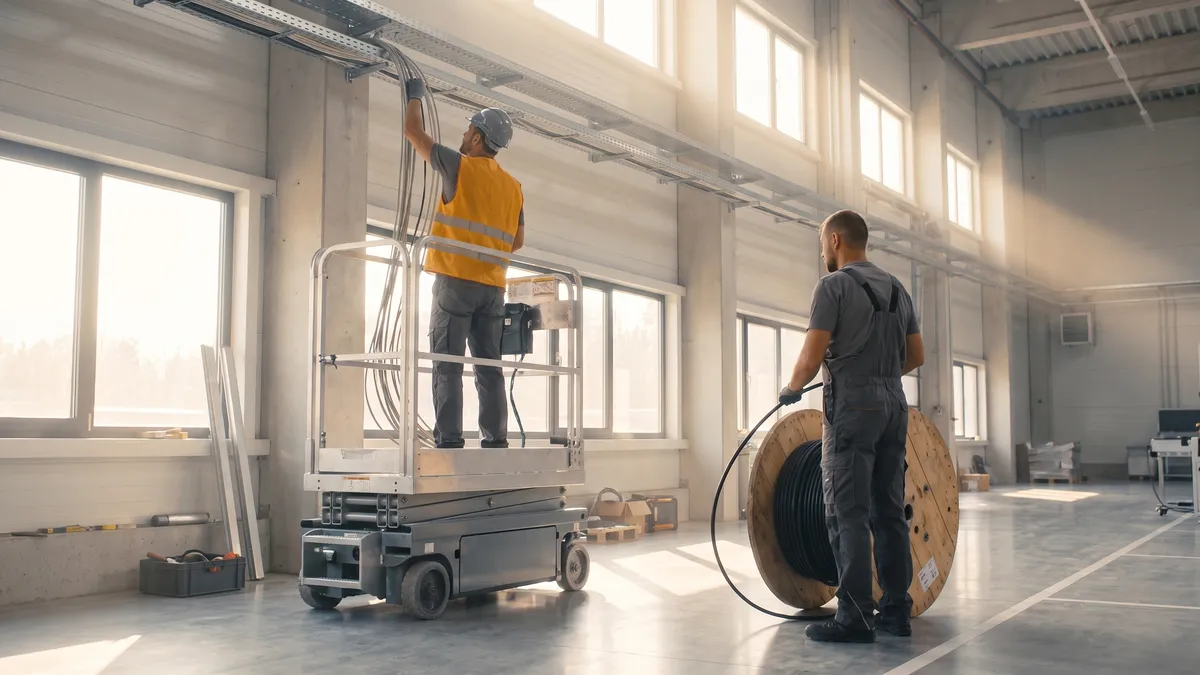
Every electrical project includes work that needs a lot of time and few technical decisions. This includes pulling cables and laying lines according to plan, building cable trays and cable ladders, and setting fixings. Pre-assembly of sub-distribution boards and control cabinet enclosures also belongs here, as does cutting cables to length and labeling them. Added to that are material logistics on the project and support during wiring. Skilled helpers with assembly experience also take on mechanical assembly in plant construction and industrial installation. This is where the leverage lies: every hour a helper spends on cable pulling frees your qualified electrician for connection, measurement and commissioning. Anyone planning installation staff for electrical projects therefore writes the task list first and only then counts heads. That way the profile fits, and nobody stands at the cable tray with the wrong job.
The line to the qualified electrician is clearly drawn, and it does not shift under deadline pressure either. Responsibility for electrical safety remains with qualified electricians. That applies to work on live installations, to measurements and tests and to the release for commissioning. Helpers work under the direction and supervision of a qualified electrician, who assigns them tasks and instructs them on the hazards. The German accident prevention regulation DGUV Vorschrift 3 describes this principle for electrical work. Supervision there means technical and managerial responsibility, not necessarily constant presence next to every helper. How you define the tasks in detail is up to your company; the legal assessment in the individual case remains with you. For planning, this means that a ratio of qualified electricians to helpers that your electricians can genuinely lead achieves more than a large number of extra hands.
We place electrical helpers from abroad through staff leasing from Eastern Europe, legally temporary staffing (German AÜG, Arbeitnehmerüberlassung). It is reserved for workers with an EU passport. The lender and employer is a licensed partner company that carries the employer obligations: minimum wage, collective agreements, social insurance and payroll tax run through that company. Arbeitina acts as intermediary and coordinator, and your company remains the client site with the duties at the place of work, namely instruction, working hours and occupational safety. The workers work in your team, according to your plans and under your technical supervision. We verify qualifications during selection on the basis of documentation, references and interviews. Where necessary, we organize trial work or onboarding. No one can confirm in advance that a worker suits every conceivable task, which is why a precise requirement profile pays off. How the process runs from inquiry to the first working day is described on our page on temporary staffing and staff leasing.
On speed, a sober view helps. From Eastern Europe, electrical helpers and fitters are as a rule on site within 7 to 10 days, counted from your approval of the profile. That is a value from experience, not a date that can be fixed in advance. It takes longer for sought-after specialist profiles, for special qualifications required for certain installations, and when the start or the number changes at short notice. Skilled helpers for assembly start at €26.90 net per hour. That is an indicative rate, binding in the quote after the requirement analysis. All inclusive as per quote are accommodation, vehicle and transport costs as well as overtime without surcharges. With changing work sites and long installation days in particular, this makes the calculation clearer. Which roles we fill in this sector, from electrical helpers and installers to plant mechanics, is shown on our industry page on electrical and trades.
Can electrical helpers without German vocational training be deployed? For tasks that do not require a qualified electrician and are carried out under the direction and supervision of one, this is the usual route. What matters is not only the certificate on paper, but whether tasks, instruction and supervision fit together. During selection we clarify what practical experience a candidate brings: cable pulling, cable tray installation, control cabinet building or industrial assembly. Whether a foreign qualification holds up in the individual case for work reserved for a qualified electrician is assessed by your company. We clarify the language level in advance, because briefings and safety instructions must be understood. A foreman with German skills who passes on instructions within the team and bundles questions is often helpful. If the assignment involves installations in an operating plant, access rules and the safety requirements there belong in the same briefing.
Is a staffing provider worthwhile if we only scale up for a single project? Especially then, because you plan installers through a staffing provider for exactly the project period without hiring permanently. You set the assignment period, extension and early termination in the contract before the first working day. Scaling up afterwards is usually faster than the first start, because the requirement profile is already in place. We organize replacement in case of absence as agreed, not as a blanket rule for every case. Plan the reinforcement along the project phases: cable tray construction and cable pulling often need more hands than the late phase with connection and commissioning. If your project depends on installation capacity and you want to plan electrical helpers from abroad, describe the assignment, tasks, number of workers and period on our contact page. You will receive an honest assessment of what is realistic by when.
This might concern you too.
Let us talk about your staffing needs.
Outline your plan and we will recommend the model that holds up commercially and contractually.